
Wedge Error Explained: Why Parallelism Matters in Optical Components
Wedge Error
7/27/20261 min read
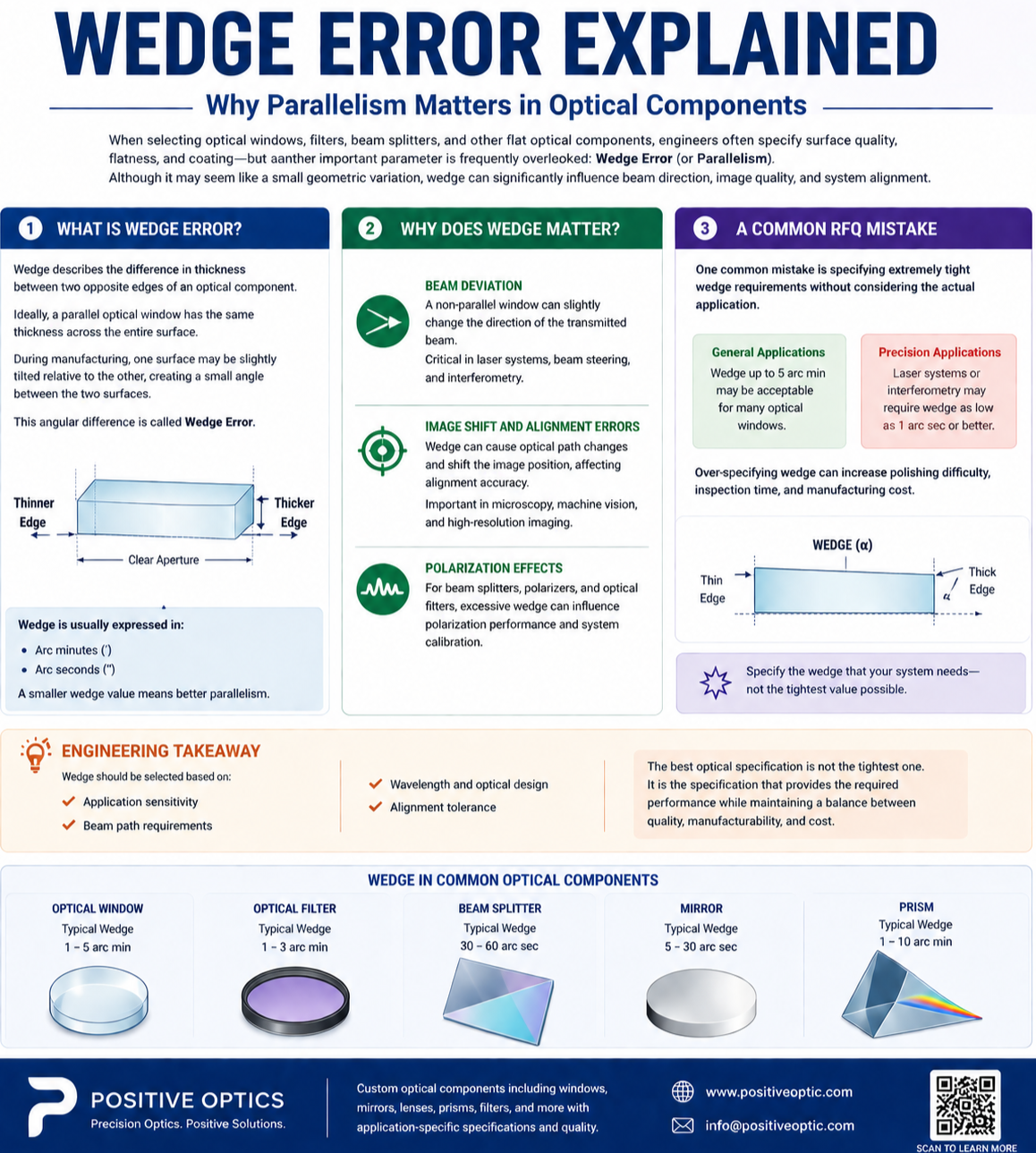
When selecting optical windows, filters, beam splitters, and other flat optical components, engineers often specify surface quality, flatness, and coating—but another important parameter is frequently overlooked:
Wedge Error (or Parallelism).
Although it may seem like a small geometric variation, wedge can significantly influence beam direction, image quality, and system alignment.
What Is Wedge Error?
Wedge describes the difference in thickness between two opposite edges of an optical component.
Ideally, a parallel optical window has the same thickness across the entire surface.
However, during manufacturing, one surface may be slightly tilted relative to the other, creating a small angle between the two surfaces.
This angular difference is called wedge error.
It is usually expressed in:
Arc minutes (′)
Arc seconds (″)
A smaller wedge value means better parallelism.
Why Does Wedge Matter?
For many general imaging applications, a small amount of wedge may have little impact.
However, in precision systems, wedge can introduce:
🔹 Beam Deviation
A non-parallel window can slightly change the transmitted beam direction.
This is critical in:
Laser systems
Beam steering applications
Interferometry
🔹 Image Shift and Alignment Errors
In imaging systems, wedge may introduce optical path changes and affect alignment accuracy.
This becomes important in:
Microscopy
Machine vision
High-resolution imaging
🔹 Polarization Effects
For components such as:
Beam splitters
Polarizers
Optical filters
excessive wedge can influence polarization performance and system calibration.
A Common RFQ Mistake
One common mistake is specifying extremely tight wedge requirements without considering the actual application.
For example:
General protective windows may not require extremely low wedge.
Laser interferometry systems may require very strict parallelism.
Over-specifying wedge can increase polishing difficulty, inspection requirements, and manufacturing cost.
Engineering Takeaway
Wedge should be selected based on:
✔ Application sensitivity
✔ Beam path requirements
✔ Wavelength and optical design
✔ Alignment tolerance
The best optical specification is not the tightest one.
It is the specification that provides the required performance while maintaining a reasonable balance between quality, manufacturability, and cost.
At Positive Optics, we manufacture custom optical components including windows, filters, mirrors, prisms, and beam splitters with application-specific requirements for wedge, flatness, surface quality, and coatings.
#Optics #Photonics #OpticalEngineering #LaserOptics #PrecisionOptics #CustomOptics