
Optical Tolerances Explained: Why Diameter, Thickness, and Centration Matter
optics
7/12/20261 min read
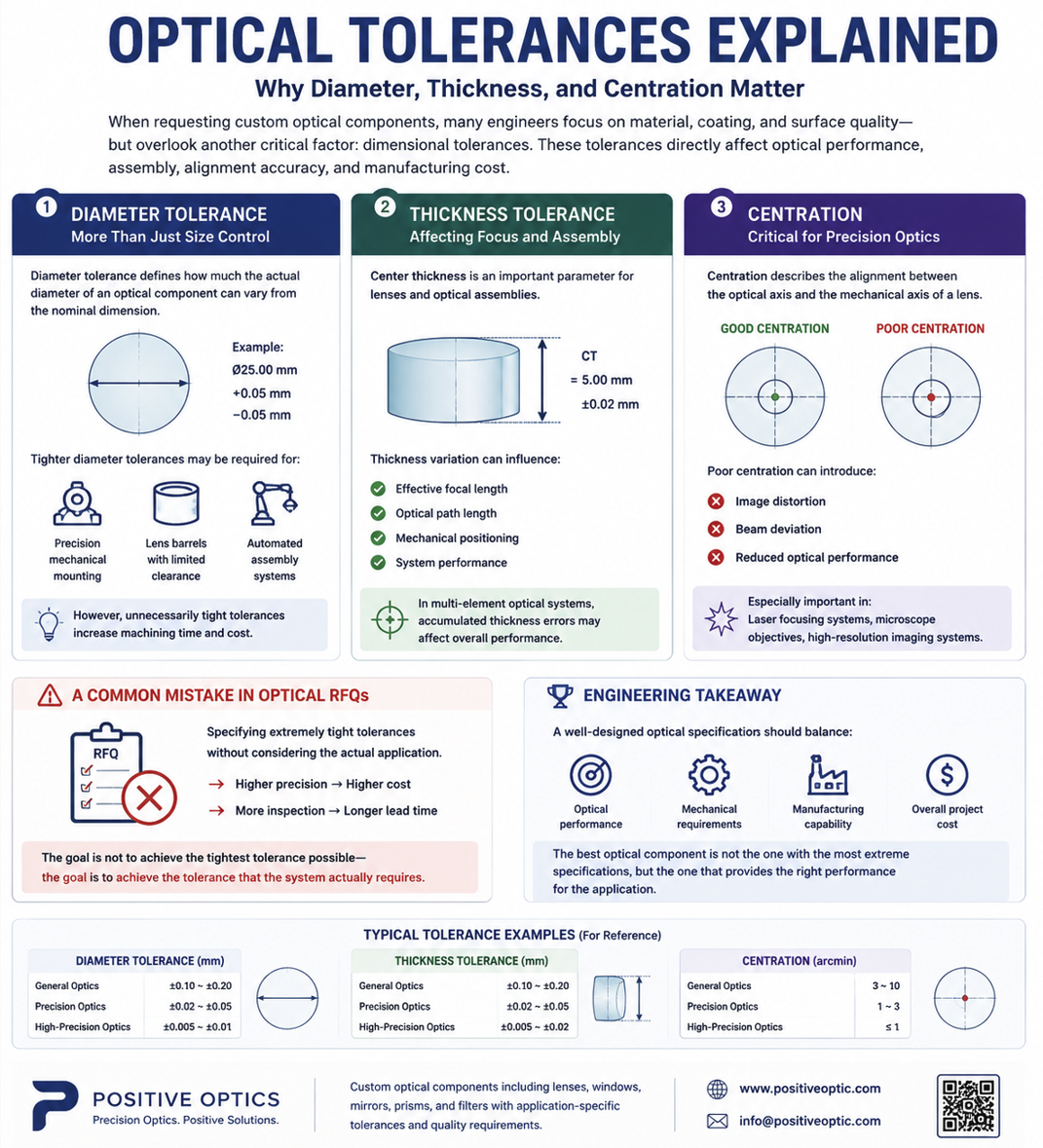
When requesting custom optical components, many engineers focus on material, coating, and surface quality—but overlook another critical factor: dimensional tolerances.
Specifications such as diameter tolerance, thickness tolerance, and centration directly affect optical assembly, alignment accuracy, and manufacturing cost.
Understanding these parameters can help prevent design issues and unnecessary expenses.
🔹 Diameter Tolerance: More Than Just Size Control
Diameter tolerance defines how much the actual diameter of an optical component can vary from the nominal dimension.
For example:
A Ø25 mm lens with a ±0.05 mm tolerance allows more manufacturing flexibility than a tighter ±0.01 mm tolerance.
Tighter diameter tolerances may be required for:
Precision mechanical mounting
Lens barrels with limited clearance
Automated assembly systems
However, unnecessarily tight tolerances can increase machining time and cost.
🔹 Thickness Tolerance: Affecting Focus and Assembly
Center thickness is an important parameter for lenses and optical assemblies.
Thickness variation can influence:
Effective focal length
Optical path length
Mechanical positioning
In multi-element optical systems, accumulated thickness errors may affect overall performance.
The required tolerance depends on the optical design—not simply the desire for maximum precision.
🔹 Centration: Critical for Precision Optics
Centration describes the alignment between the optical axis and the mechanical axis of a lens.
Poor centration can introduce:
Image distortion
Beam deviation
Reduced optical performance
This becomes especially important in:
Laser focusing systems
Microscope objectives
High-resolution imaging systems
🔹 A Common Mistake in Optical RFQs
One of the most common issues is specifying extremely tight tolerances without considering the actual application.
Higher precision always increases manufacturing difficulty and inspection requirements.
The goal is not to achieve the tightest tolerance possible—the goal is to achieve the tolerance that the system actually requires.
📌 Engineering Takeaway
A well-designed optical specification should balance:
✔ Optical performance
✔ Mechanical requirements
✔ Manufacturing capability
✔ Overall project cost
The best optical component is not the one with the most extreme specifications, but the one that provides the right performance for the application.
At Positive Optics, we support custom optical components including lenses, windows, mirrors, prisms, and filters with application-specific tolerances and quality requirements.
#Optics #Photonics #OpticalEngineering #PrecisionOptics #CustomOptics #LaserOptics