
How to Specify Custom Optical Components and Avoid Costly Mistakes
Custom Optics
6/22/20261 min read
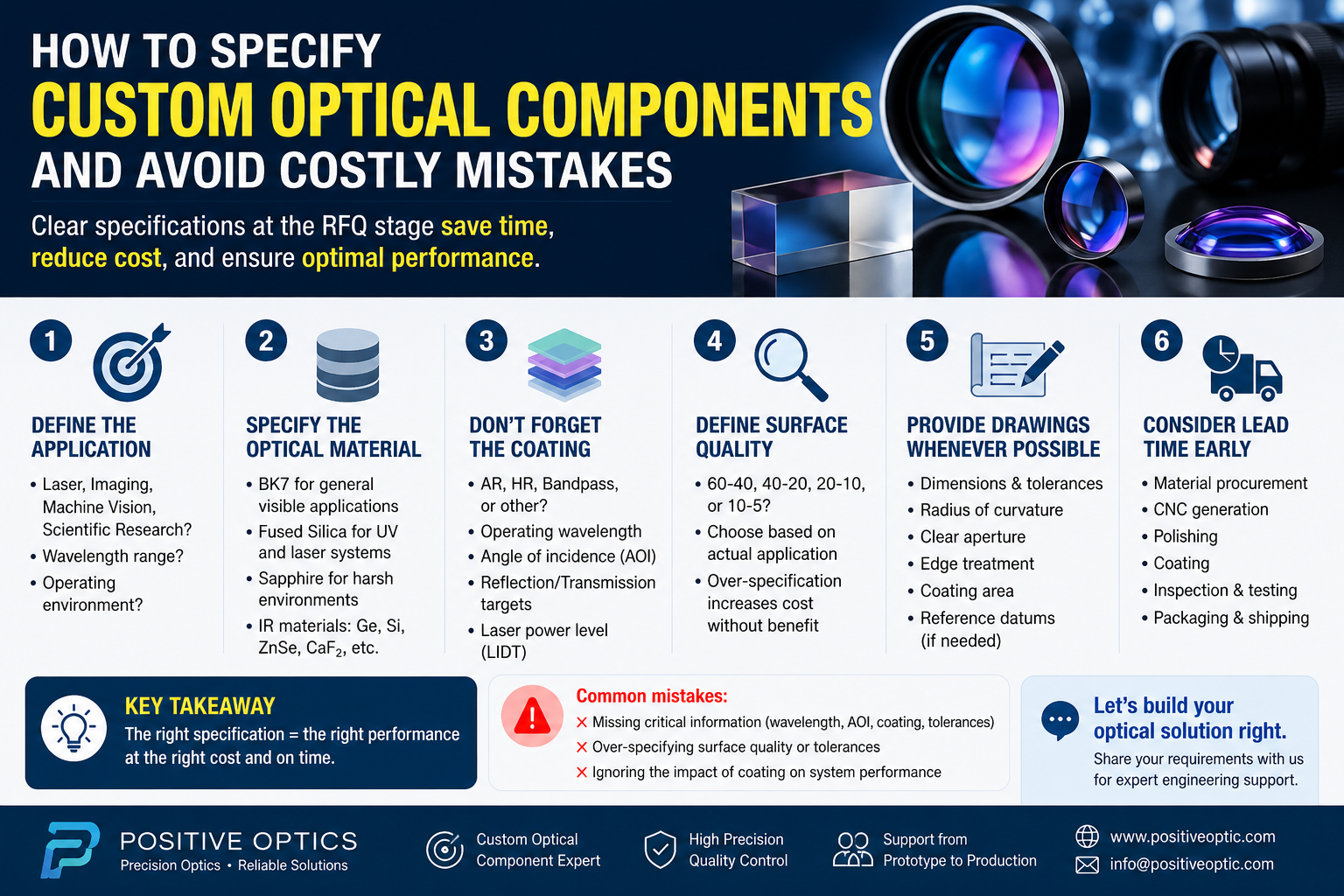
Selecting custom optical components may seem straightforward, but incomplete specifications are one of the most common causes of project delays, unexpected costs, and performance issues.
Whether you are sourcing lenses, windows, mirrors, filters, or prisms, providing the right information at the beginning can significantly reduce lead times and improve manufacturing success.
1. Define the Application First
Before discussing dimensions or materials, clearly identify the application.
Ask yourself:
Is this for a laser system or an imaging system?
What wavelength range will be used?
Is the environment laboratory, industrial, medical, or outdoor?
The application often determines material, coating, and surface quality requirements.
2. Specify the Optical Material
Different materials serve different purposes.
Examples include:
BK7 for general visible-light applications
Fused Silica for UV optics and laser systems
Sapphire for harsh environments
Germanium and Silicon for infrared applications
Choosing the wrong material can increase costs or limit system performance.
3. Don't Forget the Coating
Many optical performance issues originate from coating mismatches.
Important coating information includes:
Operating wavelength
Angle of incidence (AOI)
Reflection or transmission targets
Laser power levels
A high-quality substrate with an incorrect coating can still lead to poor system performance.
4. Define Surface Quality Only When Necessary
Specifications such as 60-40, 40-20, or 10-5 should be selected according to actual application requirements.
Over-specifying surface quality can dramatically increase manufacturing cost without improving system performance.
For many industrial applications, 40-20 is sufficient.
5. Provide Drawings Whenever Possible
A detailed drawing reduces misunderstandings and speeds up quotation.
Helpful information includes:
Diameter and thickness
Radius of curvature
Clear aperture
Edge treatment
Tolerances
Even a preliminary sketch is often better than a text description alone.
6. Consider Manufacturing Lead Time Early
Custom optics often require:
Material procurement
CNC generation
Polishing
Coating
Inspection
Understanding these steps helps avoid unrealistic delivery expectations.
Final Thoughts
The best optical component is not necessarily the most precise or expensive one—it is the component that meets system requirements efficiently and cost-effectively.
By clearly defining application, material, coating, and tolerances from the start, engineers and procurement teams can reduce risk, shorten lead times, and improve project outcomes.
Need support with a custom optical project?
Positive Optics specializes in custom lenses, windows, mirrors, prisms, and optical coatings for laser, imaging, and scientific applications.