
Flatness λ/4 vs λ/10: What Does It Really Mean in Optical Components?
Flatness
6/29/20261 min read
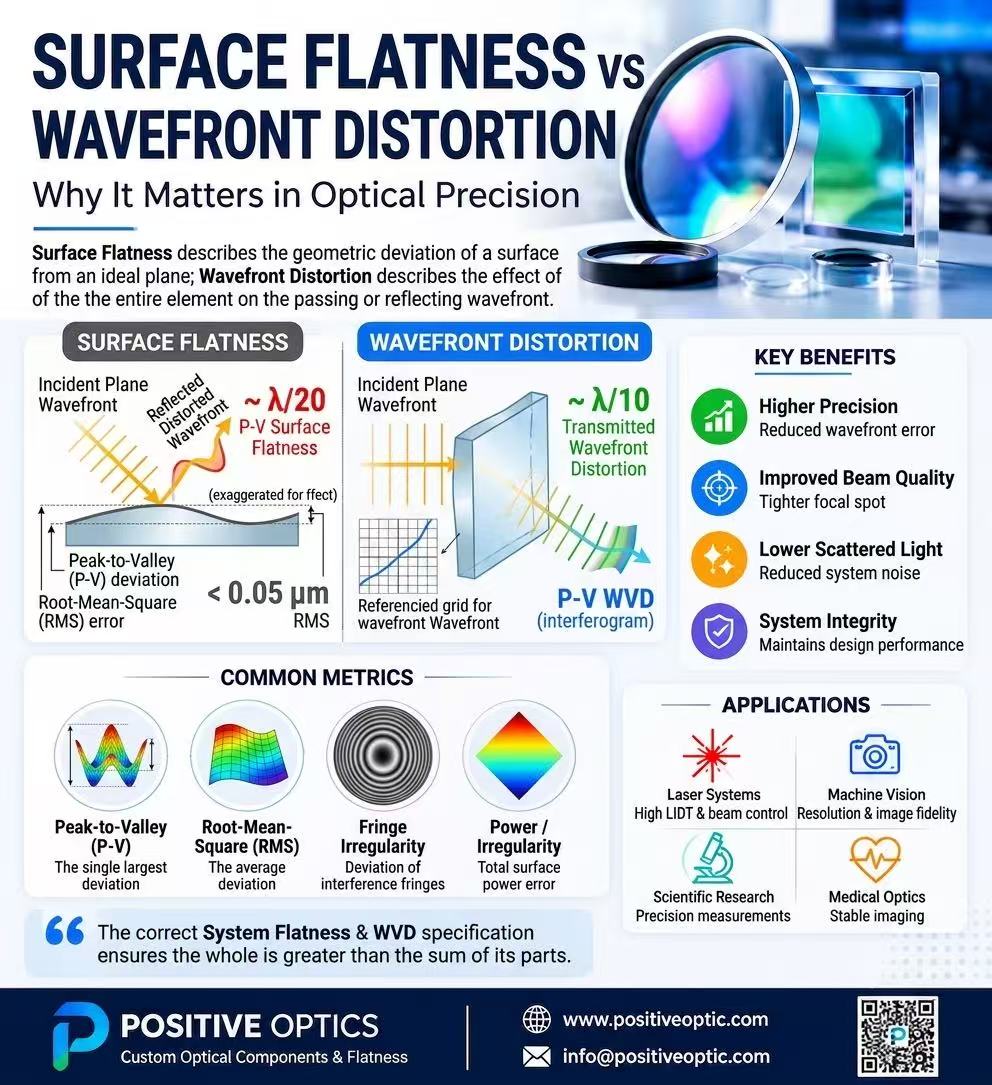
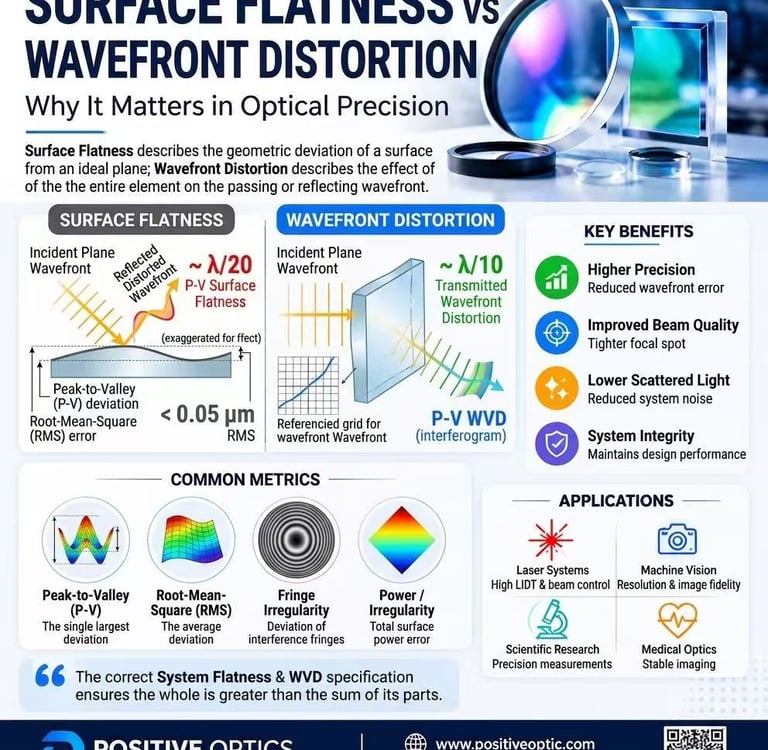
When specifying optical components such as windows, mirrors, and lenses, surface flatness is one of the most commonly misunderstood parameters in optical engineering.
Terms like λ/4, λ/8, and λ/10 flatness are frequently used, but their real meaning is often unclear outside optical design teams.
🔹 What does “flatness” actually mean?
Surface flatness describes how much an optical surface deviates from an ideal plane.
It is typically measured relative to a reference wavelength (commonly 632.8 nm He-Ne laser):
λ/4 flatness → larger surface deviation allowed
λ/10 flatness → higher precision surface
Lower value = better flatness = higher cost
🔹 Why flatness matters
Flatness directly affects:
Wavefront distortion
Beam quality in laser systems
Interference performance in precision optics
Imaging system resolution
In high-precision optical setups, even small deviations can introduce measurable wavefront error.
🔹 But here is the key engineering point
Flatness specification is often misused or over-specified.
In many practical systems:
λ/4 is sufficient for general imaging and industrial optics
λ/10 is required for high-end laser and interferometric systems
Going beyond requirement increases cost without system benefit
As noted in optical engineering practice (including industry references such as Edmund Optics technical resources), flatness must always be interpreted within the context of the full optical system—not as an isolated specification.
🔹 Flatness vs surface quality (important distinction)
Many engineers confuse:
Surface flatness → overall shape deviation
Surface quality (scratch-dig) → micro defects like scratches and pits
Both affect performance, but in different ways:
Flatness → wavefront accuracy
Scratch-dig → scattering and damage risk
📌 Engineering takeaway
Flatness is not a “higher is always better” specification.
It should always be defined based on:
✔ System wavelength
✔ Beam type (laser or imaging)
✔ Optical path sensitivity
✔ Cost-performance balance
💡 Final thought
In real optical system design, over-specifying flatness is one of the most common causes of unnecessary cost increase.
A correctly defined λ/4 system can often outperform a poorly integrated λ/10 system.
At Positive Optics, we support custom optical components with application-specific flatness, surface quality, and coating specifications for laser, imaging, and scientific systems.