
Clear Aperture Explained: Why It Matters More Than You Think
Clear Aperture
7/19/20262 min read
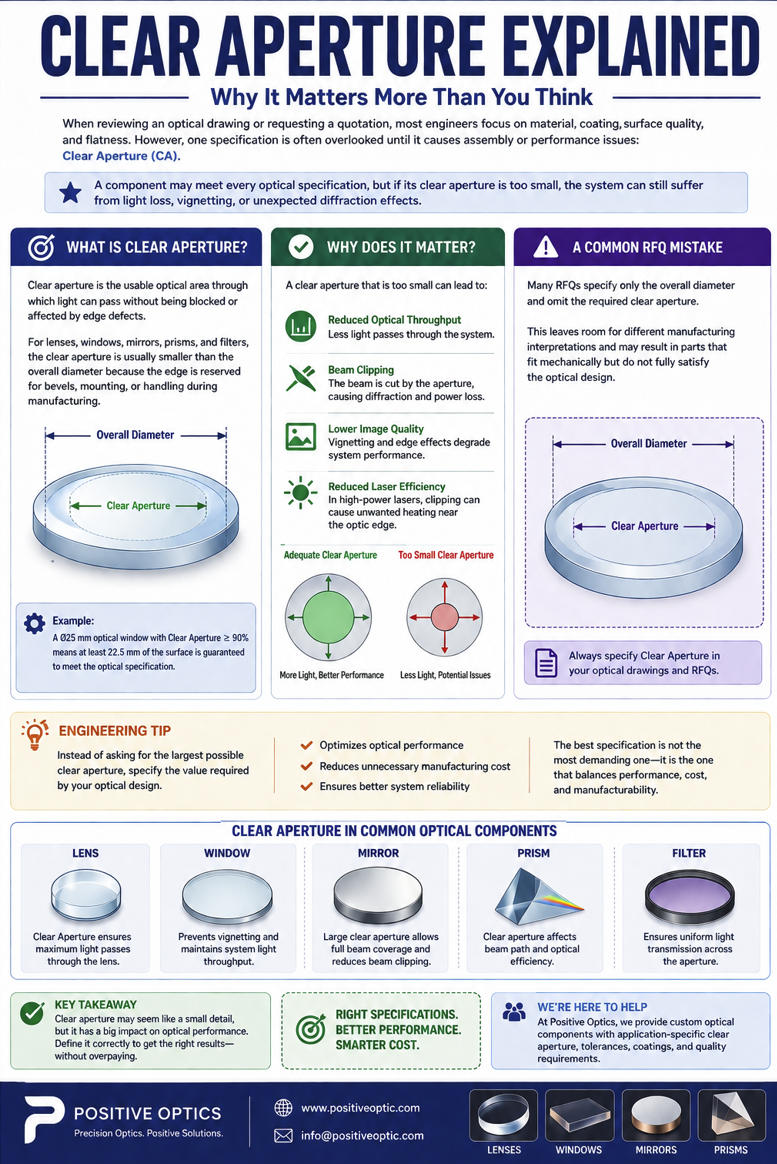
When reviewing an optical drawing or requesting a quotation, most engineers pay close attention to the material, coating, surface quality, and flatness. However, one specification is often overlooked until it causes assembly or performance issues: Clear Aperture (CA).
A component may meet every optical specification, but if its clear aperture is too small, the system can still suffer from light loss, vignetting, or unexpected diffraction effects.
What Is Clear Aperture?
Clear aperture is the usable optical area through which light can pass without being blocked or affected by edge defects.
For lenses, windows, mirrors, prisms, and filters, the clear aperture is usually smaller than the overall diameter because the edge is reserved for bevels, mounting, or handling during manufacturing.
For example, a Ø25 mm optical window may have a Clear Aperture ≥ 90%, meaning at least 22.5 mm of the surface is guaranteed to meet the optical specification.
Why Does It Matter?
A clear aperture that is too small may lead to:
Reduced optical throughput
Beam clipping
Lower image quality
Vignetting in imaging systems
Reduced laser efficiency
In high-power laser applications, beam clipping can even increase the risk of unwanted heating near the optic edge.
A Common RFQ Mistake
Many RFQs specify only the overall diameter and omit the required clear aperture.
This leaves room for different manufacturing interpretations and may result in parts that fit mechanically but do not fully satisfy the optical design.
Including a clear aperture requirement helps ensure that the usable optical area matches your system needs.
Engineering Tip
Instead of asking for the largest possible clear aperture, specify the value required by your optical design.
An unnecessarily large clear aperture can increase polishing time, coating complexity, and overall manufacturing cost.
The best specification is not the most demanding one—it is the one that balances optical performance, manufacturability, and cost.
Final Thoughts
Clear aperture is a small note on an optical drawing, but it has a significant impact on system performance.
Before sending your next RFQ, make sure this specification is clearly defined alongside material, coating, surface quality, flatness, and dimensional tolerances.
At Positive Optics, we manufacture custom lenses, windows, mirrors, prisms, and optical filters with application-specific clear aperture, tolerances, coatings, and quality requirements.
#Optics #Photonics #OpticalEngineering #ClearAperture #PrecisionOptics #CustomOptics #LaserOptics