
AR Coating vs No Coating: Why It Matters in Optical Systems
AR coating
6/15/20261 min read
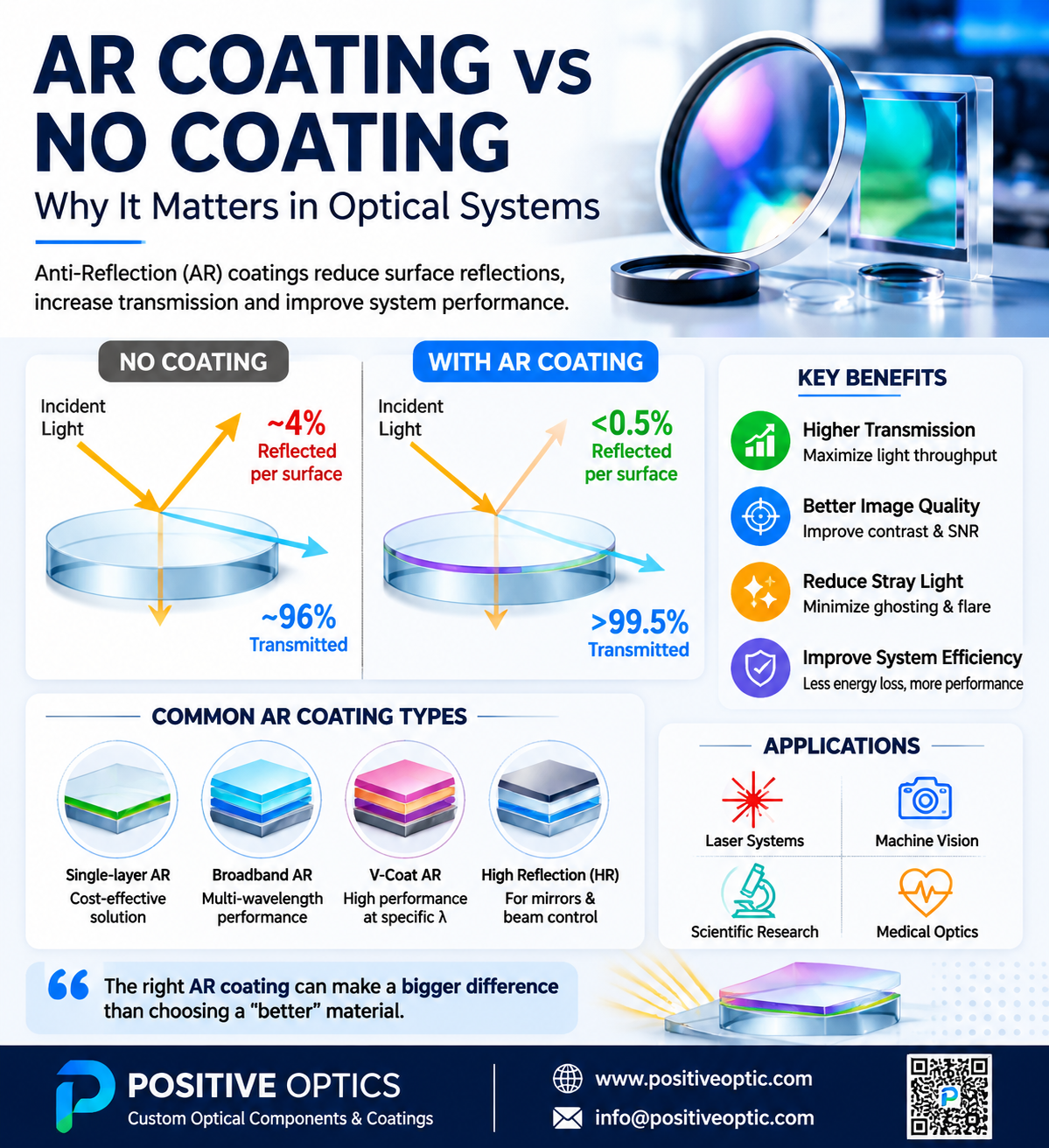
In optical systems such as lasers, imaging devices, and scientific instruments, one often overlooked but critical factor is anti-reflection (AR) coating.
Even if the optical material and surface quality are well selected, an uncoated surface can still significantly reduce system performance.
What happens without AR coating?
Every optical surface reflects part of the incoming light. For example:
A standard glass surface can reflect around 4% per surface
In multi-element systems, this loss accumulates quickly
This leads to:
Reduced transmission efficiency
Lower signal strength in imaging systems
Increased stray light and ghost images
Energy loss in laser applications
What is AR coating?
An Anti-Reflection (AR) coating is a thin-film optical coating applied to reduce surface reflections and maximize transmission.
Depending on the design, AR coatings can:
Reduce reflection to less than 0.5% per surface
Increase overall system throughput
Improve image contrast and signal-to-noise ratio
Common types of optical coatings
Single-layer AR coating → Cost-effective, basic performance
Broadband AR (BBAR) → Works across multiple wavelengths
V-coat AR → High performance at specific wavelengths
High Reflection (HR) coating → Used for mirrors and beam control
When do you need AR coating?
AR coatings are especially important in:
Laser systems (to reduce energy loss and back reflections)
Machine vision systems (to improve image clarity)
Medical optics (to ensure stable signal performance)
UV optical systems (where reflection loss is more critical)
AR coating vs system cost
While AR coating increases component cost, it often reduces overall system cost by:
Improving efficiency
Reducing power requirements
Minimizing signal correction or compensation needs
In many cases, choosing the correct coating is more important than choosing a “better” material.
Conclusion
AR coating is not just an optional enhancement—it is a key factor in optimizing optical system performance.
Understanding when and how to use AR coatings helps engineers achieve better efficiency, stability, and optical quality.
At Positive Optics, we provide custom AR coating solutions tailored for:
Laser optics
Imaging systems
UV/IR applications
🌐 www.positiveoptic.com
📧 info@positiveoptic.com
#Optics #Photonics #ARCoating #LaserOptics #OpticalCoatings #CustomOptics #MachineVision